RMS Digital Services Website
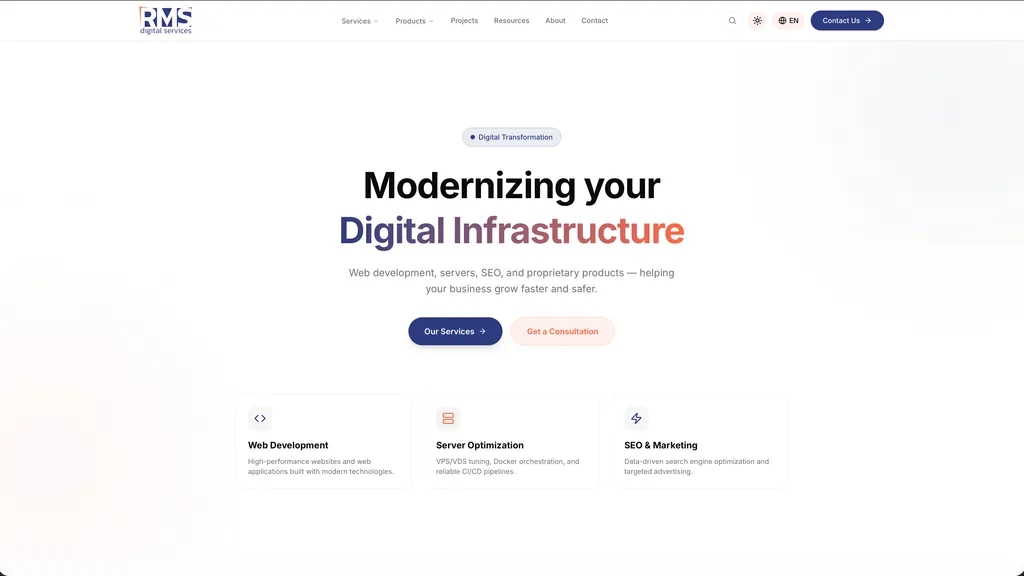
Client: RMS Digital Services (in-house)
Website: https://rms-ds.com
RMS Digital Services — is not just a corporate website, but a unified content platform that powers the company website, knowledge base, product catalog and technical documentation publishing system. The project serves as the company’s primary digital platform and simultaneously functions as a testbed for developing and validating architectural solutions that are later used in client projects.
The solution is built on Next.js, Payload CMS and PostgreSQL and is used for content management, publishing materials, promoting company products and supporting its digital ecosystem.
The main goal of the project was to create a platform equally suitable for a marketing website, knowledge base and software product catalog. The solution had to provide high performance, convenient content management, scalability and compliance with modern SEO requirements.
Key Features
Multilingual Platform
The website supports multiple languages and uses localized routes, metadata, sitemaps and structured data. Content management is performed through a single Payload CMS admin panel with translation support and editorial workflows.
CMS and Content Management
The platform allows managing pages, services, products, projects, articles, guides and marketing materials without developer involvement.
Supported:
- drafts and content versions;
- change history;
- feedback forms;
- redirects;
- media files;
- publication via visual editor.
Knowledge Base and Technical Blog
The project includes a full-fledged system for publishing articles and technical documentation with support for:
- categories and nested sections;
- RSS feeds;
- content search;
- automatic generation of structured data;
- related materials.
Content Intelligence Layer
One of the platform’s key features is its own Content Intelligence Layer (CIL) engine.
Unlike traditional CMS where links between materials are maintained manually, RMS Digital Services uses its own content graph. It automatically determines connections between articles, products, services and projects, creating a unified information space without editor intervention.
The Content Intelligence Layer is a central element of the platform architecture. The system automatically builds a graph of relationships between entities, maintains backlinks, performs background data validation and can independently fix detected desynchronizations. This ensures content structure integrity even during active project development.
The system provides:
- search for related materials;
- automatic construction of internal links;
- detection of backlinks between entities;
- graph integrity checks;
- automatic repair of broken links.
For site search, a built-in full-text search engine based on PostgreSQL is used. This eliminates the need for external services, reduces infrastructure complexity and provides fast search across articles, products and documentation.
Search indexes articles, projects, services, products and technical documentation, providing a unified navigation mechanism across the entire platform.
SEO and Search Engine Optimization
The platform was designed from the start with modern search engine requirements in mind.
Implemented:
- Open Graph and Twitter Cards;
- schema.org for different content types;
- XML Sitemap Index;
- Google News Sitemap;
- RSS feeds;
- localized URLs;
- canonical links;
- Breadcrumb markup;
- automatic metadata generation.
All published materials automatically participate in the search index and internal link graph.
Performance and Reliability
The project architecture is built around server-side rendering and static page generation.
To ensure stable operation, the following are used:
- PostgreSQL;
- background tasks via pg-boss;
- automatic content reindexing;
- data caching;
- centralized configuration management.
The platform can serve both marketing websites and large knowledge bases with extensive content.
Monitoring and Observability
To monitor quality of service, a centralized monitoring system based on Sentry and GlitchTip is used. It covers client and server parts of the application, API interfaces, background tasks and content generation processes, ensuring rapid error detection and diagnosis.
Security
Additional protection mechanisms have been implemented within the project:
- XSS protection;
- Open Redirect protection;
- SQL injection protection in search queries;
- secure secret handling;
- CSP and modern HTTP Security Headers;
- protection of service APIs against timing attacks.
Result
As a result, a unified content management system combining a marketing website, knowledge base, product catalog and technical documentation was created. The project architecture allows publishing content, maintaining SEO infrastructure, automatically building internal links between materials and scaling the website without changing core architectural principles.
Tech Stack
- Next.js 16
- Payload CMS 3
- PostgreSQL
- pg-boss
- TypeScript
- next-intl
- Sentry / GlitchTip
- Docker
- OpenResty
- GitHub Actions
Architectural Features
- Content Intelligence Layer for automatic relationship building between entities.
- Self-Healing Graph for automatic checking and restoration of content graph integrity.
- PostgreSQL full-text search without using external search platforms.
- Background task queues based on pg-boss for asynchronous operation processing.
- Full observability of Client, Server and Edge Runtime via Sentry and GlitchTip.
- Google News support and automatic generation of SEO structures for all content types.
Key Metrics
| Metric | Value |
| Locales | 3 |
| XML Sitemap | 8 |
| News Sitemap | Yes |
| Search Engine | PostgreSQL FTS |
| CMS | Payload CMS 3 |
| Task Queues | pg-boss |
| Content Graph | Automatic |
| Self-Healing Validation | Yes |
| Structured Data | Schema.org |
| Monitoring | Sentry + GlitchTip |